
Wendell’s Window
The handbook
Forty years at one window taught me the six reasons why, and the fix for each one. Which seed is junk. Which feeder I’d never hang again. Why your neighbor’s yard is full while yours sits empty — and what to change this week.
Instant download · One payment, no subscription · 30-day money-back guarantee

Who is telling you this
I’m Wendell. I have fed the birds on the same half acre for forty years, and that is the whole of my authority. I am not an ornithologist and I have never claimed to be.
What forty years at one window gets you is not expertise. It is a very long list of things that did not work. I have hung the wrong feeders, bought the bags with the ribbon on them, moved the pole when I should have left it alone, and stood at the glass in August convinced I had broken something. This book is what is left after all of that.
Every verdict in it comes with the reason it is true, so you can check it in your own yard rather than take my word for it. That is the whole deal.

What is actually in it
Ten diagrams throughout — drawn for this book, not stock. This is one of them, straight off the page:

Six weeks. One feeder, two bags of seed, and a dish of water.
The part you will actually use
Each one is a single page, set in large type, built to be printed and stuck inside a cabinet door or folded into a coat pocket. If you never read another word of the book, these four pages have done the job.
Take it to the aisle. Two tests that rule out most of the shelf, and the three numbers nobody checks.
What is in the bag, who eats it, and what is filler you paid for.
Twelve months on one page. For the counter.
Seven checks in the order to run them, from the most likely cause to the least.
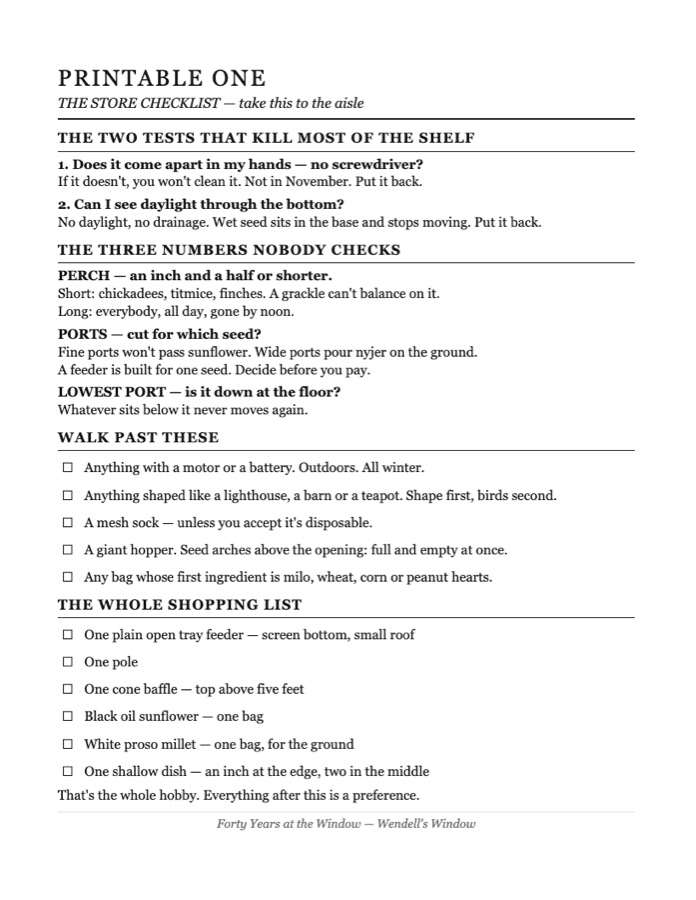
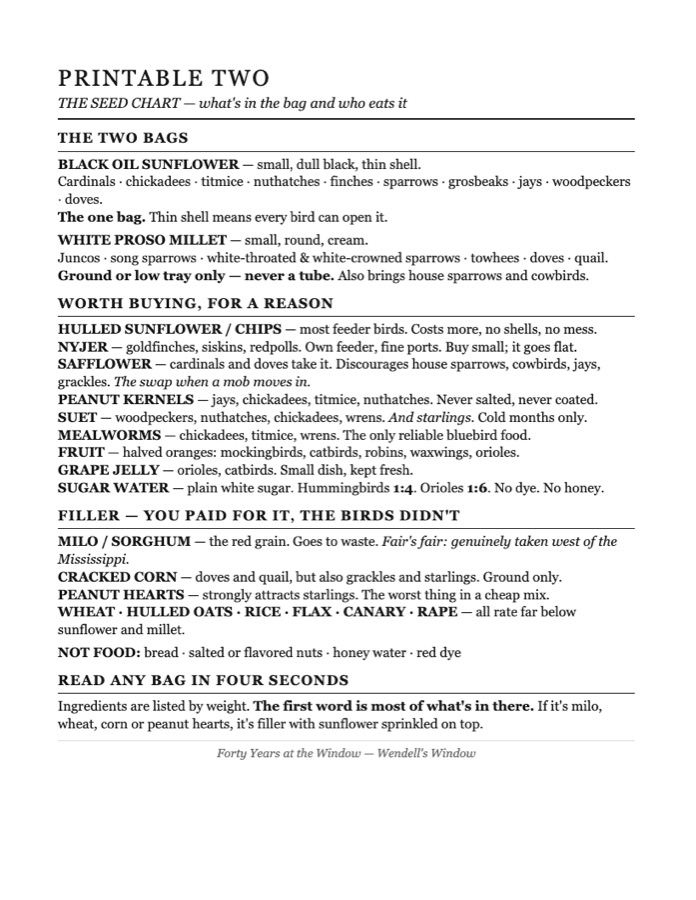
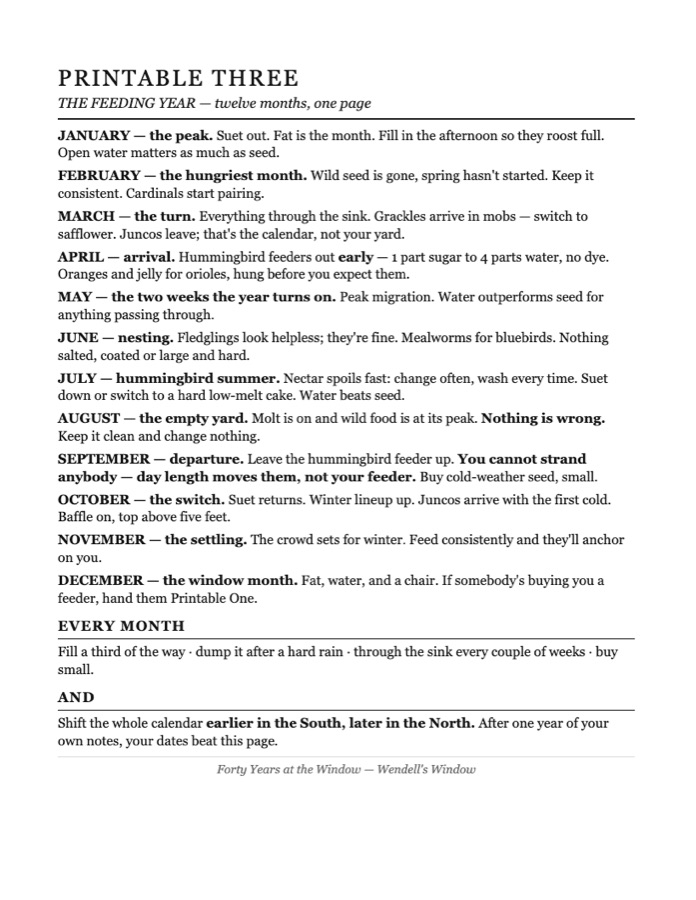
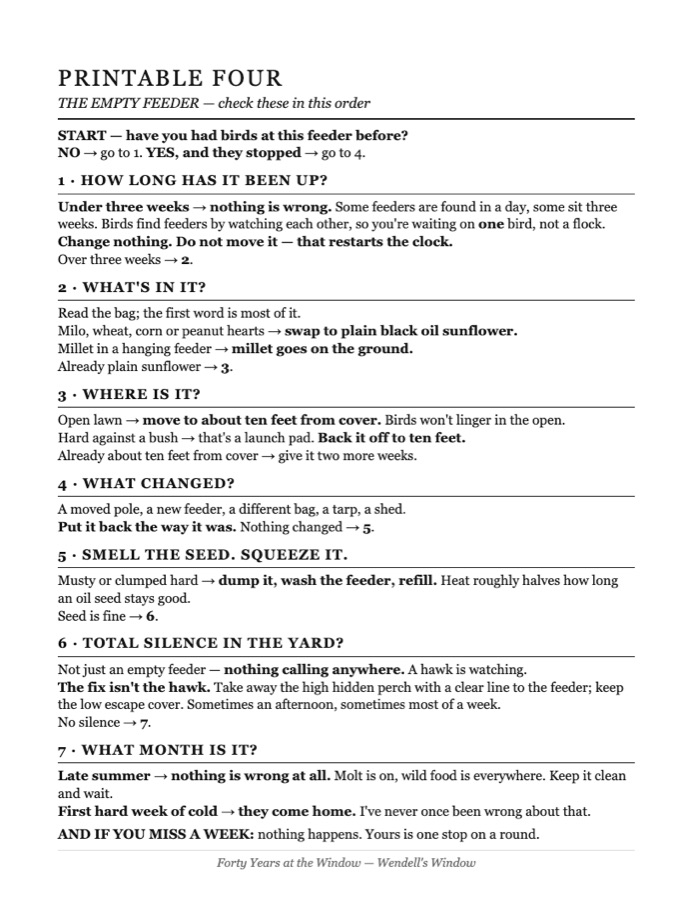
Those are the actual pages, at actual size.
The arithmetic
Here is the sum nobody does standing in the aisle. Ingredients on a seed bag are listed by weight, so whatever is printed first is most of what is in there — and in most cheap bags that first word is milo, wheat or cracked corn.
The birds take out the sunflower and kick the rest into the dirt. So a bag that is half filler is not a cheap bag. It is a bag at roughly double its sticker price, plus a mess under the feeder that feeds things you did not invite.
| A mix that is half filler | ~2× per pound eaten |
| One bag, plain black oil sunflower | 1× |
| Feeders bought on the seven checks | Bought once |
| The four printed pages | Used every trip |
No dollar figures, because seed prices differ by region and by year and anyone quoting you a national number is guessing. The ratio is the part that holds.
One wrong bag of seed costs about what this book costs. The difference is that you will buy the bag again next month, and next season, and the one after that. The book you buy once.
Two things to know before you buy
Not one, anywhere, and that is on purpose. Brands change, get bought, get worse. What a bird needs from a feeder does not change at all. So instead of a product list that is stale in three years, you get checklists you can carry into any store — including stores that do not exist yet. It also means nobody paid for a single verdict in here.
And it is not an identification guide. There are excellent ones and this is not competing with them. This is the other half of the job: the decisions. What to buy, where to put it, what to do in March, and what to do when nothing comes.
Questions
A 70-page PDF, downloaded the moment you pay. Nine chapters, ten diagrams, and the four printable pages. Set in 14pt type throughout and designed to print at home in black and white.
No. Chapter One assumes an empty yard and a person who has never hung a feeder. If you have been at this for years, start at Chapter Two and argue with me.
No. The videos take one topic at a time and you cannot flip through them. This is the finished system, in order, with every verdict already made and the reasoning attached.
The verdicts hold anywhere in the United States. Where a region genuinely changes the answer — milo west of the Mississippi, the calendar running early in the Gulf states and late in the North — the book says so, and tells you how to shift it for your own yard.
Some of it, within days: a seed swap changes your crowd on the next fill. The full setup is a six-week process, which is exactly why Chapter One is built week by week — most people quit in week two, right before it works.
If it is not for you
Buy it, read it, print the four pages and take them to the store. If it turns out not to be what you wanted, ask for your money back within thirty days and you will get it. That is handled at checkout — you do not have to email me, and you do not have to explain yourself.
I would rather you had your $15.99 back than a book you did not want.
One payment. No subscription, no upsell, nothing else to buy.
Thirty-day money-back guarantee.
Not ready to buy
The Store Checklist is the page I would hand you first. Two tests that rule out most of the shelf, the three numbers nobody ever checks, and the whole shopping list for a working yard — on one printable page in large type.
It is not a sample or a teaser. It is the actual page out of the book, and it is yours for an email address. Print it, fold it into your coat pocket, and stop guessing in the aisle.
